How Many Cold Calls Does It Take to Get One Client? Data, Benchmarks and Examples
Published on October 24, 2026

Maroosha Nageen
SEO Content Writer · LinkedIn
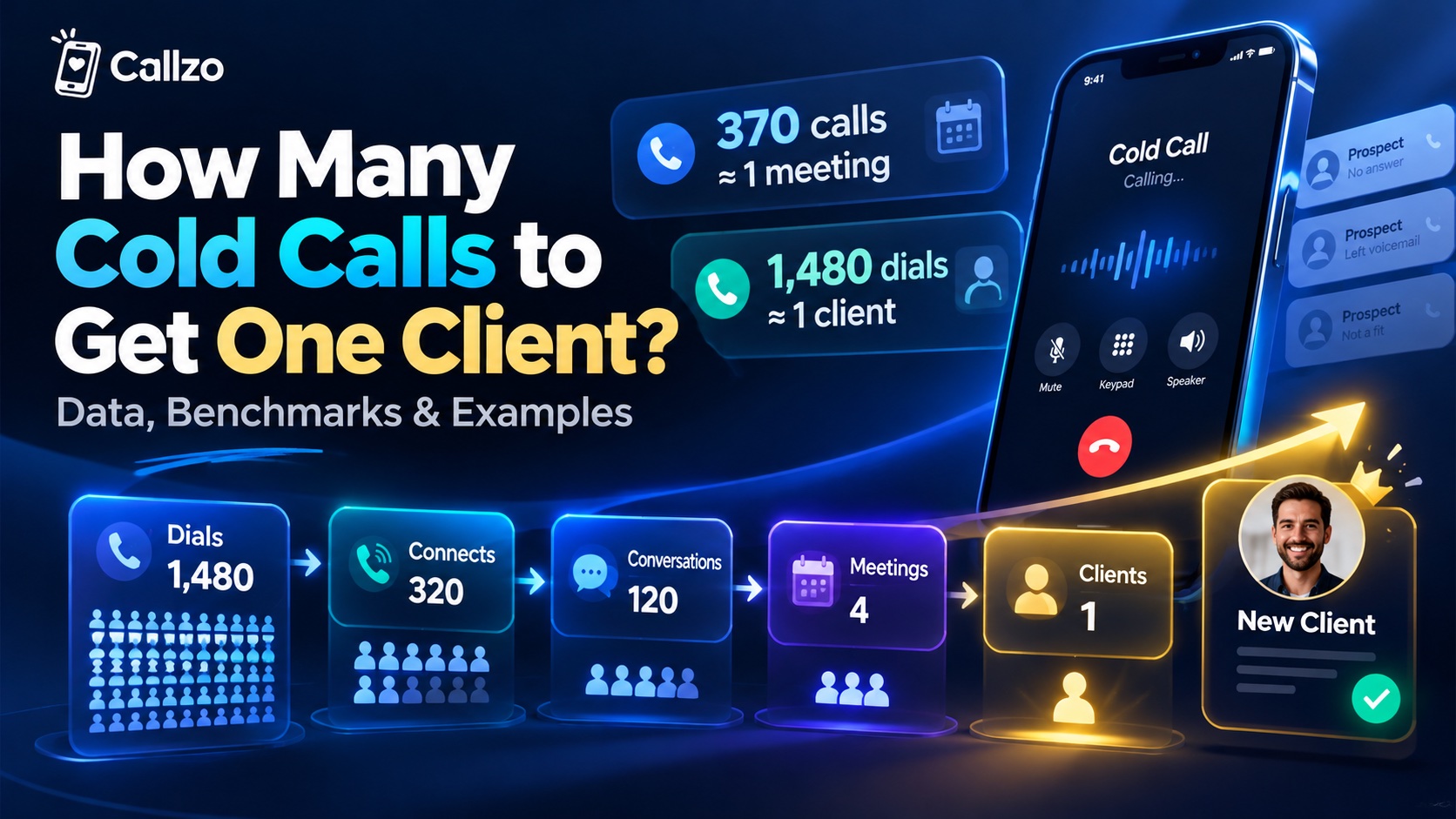
Belkins' 2026 benchmark study of 175,000+ dials found roughly one booked meeting per 370 calls (yes, 370). One meeting. Not one client. Suddenly "just make more calls" sounds less casual, doesn't it? So how many cold calls does one client actually take?
Quick Answer
In our illustrative math, somewhere near 1,500 dials. Belkins' data points to about 370 dials per meeting. Pretend one in four meetings turns into a client (a placeholder, not a stat); that works out to 1,480. Your service, list and script will move that number a lot. We've laid out the sources, the math and the fine print below.
Key takeaways
- Belkins' 2026 data shows about one booked meeting per 370 dials. That's meetings, not clients.
- Cognism and Gong measure success per conversation or per call. Their rates can't be compared directly.
- Our worked example lands near 1,500 dials per client. Your numbers will differ.
- Every benchmark here comes from sales teams. Not one is from solo freelancers.
- Month, country and list quality all swung Belkins' results.
- Count five things (dials, connects, conversations, meetings, clients) and your own numbers can replace ours.
What Counts as a Dial, a Connect and a Conversation?
Most articles skip this step. Belkins defines a dial as any outbound call attempt. A connect reaches a live human (gatekeepers and "not interested" included). A conversation means the prospect engaged beyond the greeting. Its meeting rate is meetings divided by conversations. Mix them up? The benchmarks start lying to you.
We'd ask one boring question of every figure: divided by what? Here's a made-up week. You dial 100 numbers. Ten people pick up. Six talk beyond hello. One books a meeting. Your connect rate is 10%. Your conversation rate is 60%. Meetings? About 17% of conversations. Jot your own definitions down first; future you will thank you.
Step One: Count Meetings Per Client
Let's build one illustrative calculation. Every input below is a placeholder except Belkins' 370 dials per meeting. After a few weeks of tracking, your numbers get to replace ours.
How many first meetings turn into paying clients? Nobody knows until you've held some. For this example we'll assume one in four (25%), which is pure placeholder. That means four meetings per client. A close rate of one in two needs just two meetings. One in ten needs ten. Which sounds closer to you today? Guess low at first. Then correct it after your first ten meetings.
Step Two: Work Backward to Dials
Four meetings times roughly 370 dials? That's 1,480. Want a sanity check? Divide four meetings by 4.6% and you land near 87 conversations. At a 58% conversation rate that's 150 connects. At 9.9%, roughly 1,515 dials. Close enough (all rounded and illustrative). One spreadsheet formula handles all of it, if you like that sort of thing. Yours could be 800. It could be 3,000. Honestly, that spread is the point.
Step Three: Turn Dials Into Calling Days
Say you dial 40 numbers on a calling day (another placeholder). That's 37 days for 1,480 dials (roughly seven and a half weeks of daily calling). Slow? A bit. Now flip it. A $1,200 client spread across 1,480 dials makes every dial worth about 80 cents. Not bad for a "no answer." And those early calls? They're tuition. Practice should lift your rates over time (hopefully).
What Happens When Your Meeting Rate Changes?
Small changes in meeting rate swing the dial count enormously. This table holds Belkins' connect rate (9.9%) and conversation rate (58%) fixed and varies only the meeting rate. Every row is illustrative. The client rate stays at our 25% placeholder.
| Meeting rate per conversation | Dials per meeting | Dials per client (4 meetings) |
|---|---|---|
| 4.6% (Belkins) | about 380 | about 1,510 |
| 2.4% (about half of Cognism's 2024 rate) | about 725 | about 2,900 |
| 1.5% (placeholder, borrowed from Gong's per-call baseline) | about 1,160 | about 4,640 |
Look at the jump from row one to row two. One input nearly doubles the dials. That puts the answer anywhere from about 1,500 to 4,600 dials. Only your own data narrows it.
What Can Move Your Numbers?
Benchmarks can't see the levers in your hands. Three show up in the data (why you call, who you reach, when you dial). None comes with a guarantee; test each one.
Does a Researched Reason Help?
Gong's 90,380-call study found that stating a reason for the call lifted success 2.1 times. That's the closest thing to a lever in the data. A reason means something you observed: a slow homepage, a stale blog, a missing booking button. Generic calls give prospects nothing to react to. Gong doesn't say how it labeled a "reason," so treat 2.1 as a hint.
Does Who You Reach Matter?
Apparently, yes. Belkins found managers had an 11.1% live rate. C-level contacts produced only follow-up requests, not live bookings. Directors booked the largest share of meetings (no figure given). For a freelancer pitching a local business, the owner may be the only decision-maker. That differs from a corporate org chart. A mid-level title isn't always your target. Learn who actually signs off.
Do Day and Hour Matter?
Maybe a little, if at all. Cognism points to Tuesday for booked meetings. Belkins found Wednesday had the best positive-outcome rate, with 3 to 4 p.m. and 6 p.m. local time standing out. They disagree. Different datasets, different prospects. So test your own windows. Our best time to call US clients guide covers the time-zone math. Follow-ups matter too: Cognism found three attempts captured 93% of conversations.
How Should You Track Your Own Funnel?
Five numbers: dials, connects, conversations, meetings, clients. A plain sheet works fine. Callzo's CSV import loads your prospect list. Its built-in CRM keeps notes per contact. Call history logs duration, direction and timestamp (not audio). Right after each call, tag the outcome with the same five labels every time (no answer, gatekeeper, not interested, follow-up, meeting).
Consistent labels beat clever ones. Friday afternoons are good for a look at the sheet. What are you looking for? Four ratios: connects per dial, conversations per connect, meetings per conversation, clients per meeting.
Somewhere around 200 dials, patterns start showing up. Our cold calling guide covers the wider workflow.
When Should You Change Your Approach?
Your funnel will tell you, if you let it. Plenty of connects but no meetings? Your opener or offer needs work (our SEO scripts may help).
- Few connects? Check your list and calling hours before blaming your pitch.
- Few meetings per conversation? Read your last ten call notes aloud and listen for the stumble.
- Lots of meetings but no clients? The problem sits after the call.
Start with whichever stage looks weakest. And change one thing at a time; otherwise you'll never know what helped. Don't judge anything before roughly 200 dials. That's our rule of thumb, not research.
Ready to Find Your Own Number?
Benchmarks are a map, not your location. Your real number shows up only after you've counted for a while.
So, how many dials are you making this week? We'd say 100. Log every outcome (yes, the boring ones too).
With Callzo you get a dedicated US number, browser calling and notes on each contact, all in one place. It can't promise meetings or clients. It does make the counting easier.
About the Author
Maroosha Nageen
SEO Content Writer
Maroosha writes freelancer outreach and client-acquisition guides for Callzo, focused on practical, honest scripts and systems Indian freelancers can actually run. For this piece she dug into the Belkins, Cognism and Gong benchmark reports and built out the dials-per-client math so freelancers can replace the placeholders with their own tracked numbers.
Connect on LinkedIn →Frequently Asked Questions
How many cold calls does it take to get one client?
There is no universal number. Belkins’ 2026 benchmark study of 175,000+ dials found roughly one booked meeting per 370 calls, and meetings are not clients. In an illustrative worked example that assumes one in four meetings becomes a client, the total lands near 1,480 to 1,500 dials. Your actual number depends on your service, your list and your script.
What is a good cold call connect rate?
Belkins’ 2026 data shows an overall connect rate around 9.9%, with managers reaching an 11.1% live rate. Connect rate is simply the share of dials where a live human picks up, including gatekeepers and quick "not interested" responses, so it should be tracked separately from conversation rate and meeting rate.
Does the day or time of a cold call matter?
The benchmarks disagree, which suggests it depends on the dataset and audience. Cognism points to Tuesday for booked meetings, while Belkins found Wednesday had the best positive-outcome rate, with 3 to 4 p.m. and 6 p.m. local time standing out. Cognism also found that three call attempts captured 93% of conversations, so persistence may matter more than the exact day.
How many calls should a freelancer make per day?
There is no published freelancer-specific benchmark; the Belkins, Cognism and Gong figures all come from sales teams, not solo freelancers. A simple starting placeholder used in this guide is 40 dials per calling day, which is enough to collect a usable sample of outcomes within a few weeks without the day becoming unmanageable.
Related Posts
Cold Calling
How to cold call US clients from India
The wider workflow this benchmark math plugs into.
Lead Generation
How to Find Qualified US Business Leads for Cold Calling
Better lists change every number in this funnel.
Scripts
Best Cold Calling Opening Lines for Freelancers
What to say once a dial turns into a conversation.
Follow-Up
How to Follow Up After a Cold Call
Where many of your meetings-per-client actually come from.
Stop guessing at your conversion rate and start tracking it on real calls. Visit Callzo.
Ready to Make Your First Hundred Dials?
Call from a dedicated US or Canadian number in your browser, log every outcome against the same contact, and let your own funnel replace these placeholder numbers.
Try Callzo