How to Follow Up After a Cold Call: Timing, Email Templates and Examples
Published on October 24, 2026

Maroosha Nageen
SEO Content Writer · LinkedIn
“Send me something.” Hear that on a call and the clock starts ticking. In Baylor's 2011 cold-calling study, 132 of 1,774 answered calls ended in a callback request, about 7%. Somebody asked to hear from you. So how do you follow up after a cold call without sounding desperate?
We've noticed a pattern. Freelancers rehearse the call for ages, then wing everything after it. The script gets an hour of polish while the follow-up gets a limp “just checking in” two weeks late. Odd, since that's the moment interest becomes a conversation or quietly evaporates. What follows is the plan we'd run, with messages you can borrow. Opinion gets labeled as opinion.
Quick Answer
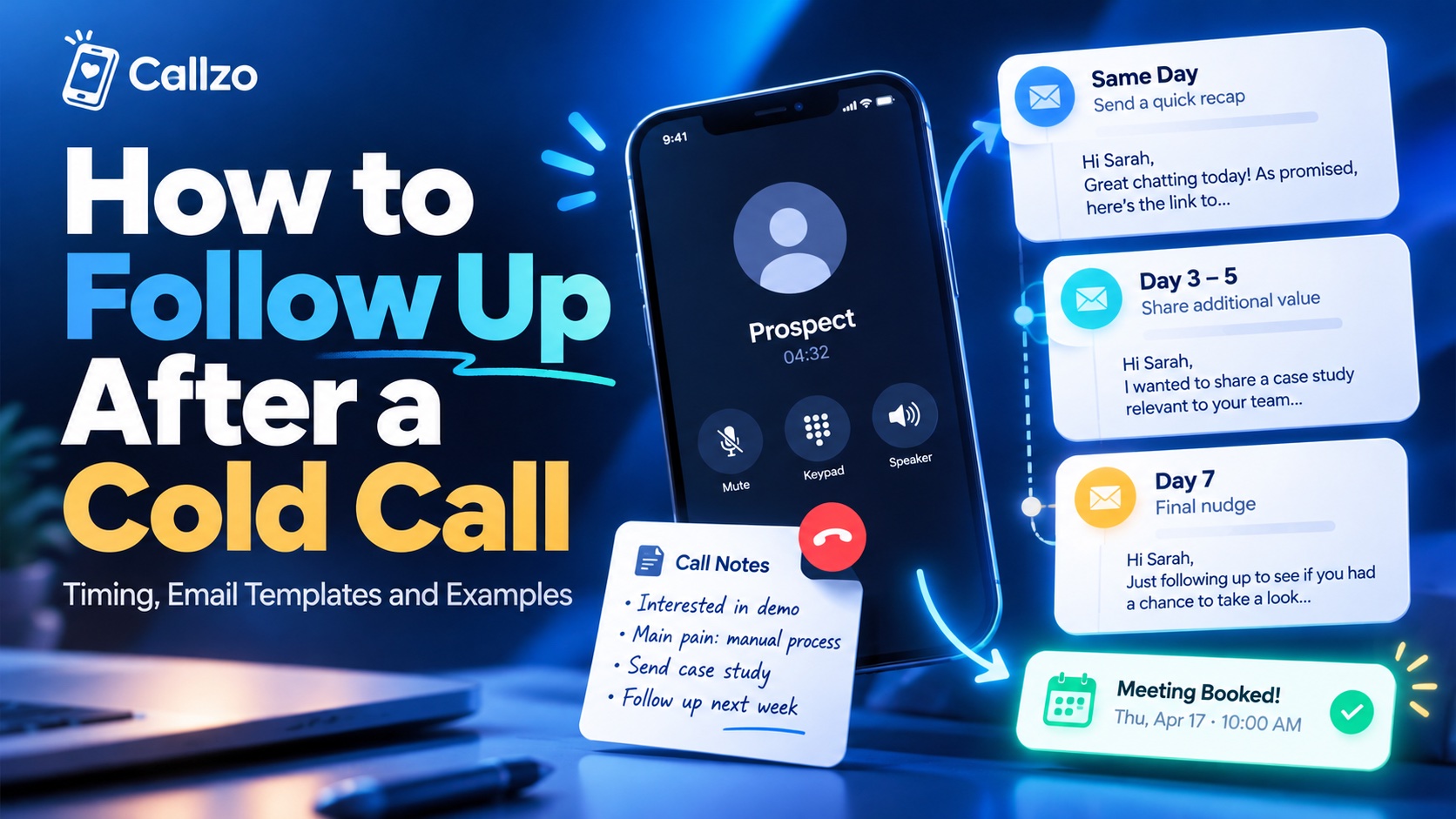
Send an email the same afternoon that quotes the prospect back to themselves. Call or leave a voicemail two days on. Add something new, such as a screenshot or mock-up, around day four. Make a last call on day seven, then send a polite goodbye by day ten. Four touches, one small ask each. That is a timeline we built ourselves, not a figure from a study.
Key takeaways
- Speed: email within hours, because a week-old chat feels like a stranger's.
- Their words: quote them rather than guessing at their problem.
- One ask: one easy question per message, never three.
- Something new: “just checking in” adds nothing. A fresh detail does.
- A limit: four touches in ten days, or one clear no.
How Do You Follow Up After a Cold Call?
Our rhythm: an email the same afternoon that quotes the prospect back to themselves. A call (or voicemail) two days on. Something new around day four, say a screenshot or mock-up. A last call on day seven, then a polite goodbye by day ten. Four touches, one small ask each. We came up with that timeline ourselves. No study backs it.
If the call did not go anywhere, it helps to know why it was so hard to begin with. Our guide to handling cold calling objections covers what to say when a prospect pushes back before you ever reach the follow-up stage.
Why Does Follow-Up Speed Matter?
Harvard Business Review once looked at 1.25 million web leads. Firms that reached a lead within an hour were nearly seven times as likely to qualify it as firms that waited one hour longer. Caveat: those leads filled in web forms. They weren't cold-call recipients. Please don't read it as a promise. But a callback request is the same raised hand.
Quick illustration: at Baylor's 7% rate, 100 answered calls yield about seven callbacks. Losing two of them to a slow reply stings.
What Should You Send in the First 24 Hours?
Picture a handshake after a short chat. Nothing fancy! Quick, warm, a little specific. Here's how we'd build the email, piece by piece.
The Subject Line
Plain wins every time. “Quick follow-up from today's call” works fine. So does “That booking form we talked about.” Anything shouty or salesy gets a thumb on the delete key. They already know who you are. You're only nudging a memory.
Don't audition for a copywriting award. If you promised something specific on the call, name it in the subject, because a promise kept is the best opener you'll ever write.
The Body
We keep it to four lines. Thank them, echo something they said in their own words, offer one tiny next step and ask a single question. That echo punches above its weight, since hearing your problem described accurately feels oddly personal. A skeleton you can borrow:
Hi [Name], thanks for the quick chat today. You mentioned [their exact problem]. I recorded a two-minute video showing where it happens. Want me to send it over?
[Your name] · [your number]
What to Leave Out
Pricing, attachments and portfolio dumps can all stay in your drafts folder. (Who opens a stranger's PDF between appointments?) Skip the apology as well.
A friendly email after a call is hardly a crime. And please don't stack three asks in one message. One question gets answered. Three get “I'll look later,” which usually means never. Don't embellish either. “I know you're losing customers” is a guess in a nice jacket.
How Do You Follow Up by Call and Voicemail?
The email opens the door. The phone call usually gets the answer. About two days later we'd ring once, at a different hour than the first attempt. We'd open with a fact: “I emailed Tuesday about your booking form. Did it reach you?” If it goes to voicemail, stay under thirty seconds.
Something like “Hi [Name], it's [you]. I emailed Tuesday about [the specific thing]. My number is [number]. Again, [number].” Slow down on the digits (nerves make everybody gallop). Then send a matching email within ten minutes.
A dedicated US or Canadian number that rings in your browser means the callback actually lands with you, with a local caller ID the prospect recognizes rather than a random overseas number they let go to voicemail. For more on why that matters, see our guide on how to cold call US clients from India.
What If They Asked You to Call Back?
Remember those 132 callback requests from Baylor? This is that group. Frankly, they're a gift. Think of the time they named as a dentist appointment. We'd scribble the day and hour before the phone's even back on the desk. An alarm goes off five minutes early. Then you dial on the dot. Running late? Call anyway and say so. Keeping a promised time costs you nothing. Missing it costs the lead. Nobody ever phones to tell you why.
Check the time zone twice, too. Our guide to the best time to call US clients from India helps you avoid the obvious scheduling slips.
What Does a 10-Day Sequence Look Like?
Here's the schedule we'd start with. It's a sketch, not a benchmark. Bend it around your prospect and your service.
| Day | Channel | Goal |
|---|---|---|
| 0 | Call, then email | Recap and one small ask |
| 2 | Call or voicemail | Confirm the email arrived |
| 4 | Add something new | |
| 7 | Call | Get a yes, a no or a date |
| 10 | Close the loop politely |
What Should “Something New” Be on Day Four?
“Just checking in” asks for attention while offering nothing. People ignore it. A small, concrete gift gives them a reason to write back, ideally something that took you twenty minutes. Our suggestions (not tested results) by service:
| Your service | Day-four idea |
|---|---|
| SEO | A screenshot of where they rank for one local search |
| Web design | A short recording of their slowest page on a phone |
| Development | A note on where the form or checkout breaks |
| Content writing | Two headline ideas for their latest blog post |
Add a sentence of context and one question. Done.
What Do You Do With Each Kind of Reply?
Replies tend to land in four buckets. Each calls for a different move:
- A yes: offer two specific times within a day, then confirm in writing.
- “Not now”: ask when to try again, log the date and call on that exact day.
- A no: thank them in one line and close the file. Don't argue.
- Silence: carry on with the sequence, then stop at touch four.
How Many Follow-Ups Are Too Many?
We stop at four touches in ten days, plus maybe a single note a month later. Past that you're not following up anymore. You're hovering. Someone says no or sounds annoyed? Quit early. A request to stop is final. Log it and never dial that number again. We like a sign-off along the lines of, “I'll stop here so I don't clutter your inbox. If timing changes, I'm easy to find.”
What Do the Rules Say?
Now for the unglamorous bit (and yes, we're no lawyers). The FTC's CAN-SPAM guide says the law makes no exception for business-to-business email. Opt-outs must be honored within 10 business days.
Penalties can reach $53,088 per email. Canada's CASL, per the CRTC's FAQ, generally wants consent, a clear sender and an unsubscribe method, with a narrow B2B exemption. A one-line opt-out in your template costs nothing.
The call side has its own rules too. If you have not already checked them, our guide on whether it is legal to cold call US businesses from India is worth reading before your first touch, not your tenth.
How Do You Track Follow-Ups?
Ten days sounds short until you're juggling forty contacts. That's when leads slip away, mostly because nobody remembers who said what. We keep five notes per contact: the date, their words, what you promised, their best hour and the touch count.
Callzo's contact notes can hold all five. A CSV import brings in a prospect list.
Call history logs duration, direction and timestamp (no audio). Your dedicated US number lets callbacks reach you in the browser.
About the Author
Maroosha Nageen
SEO Content Writer
Maroosha writes freelancer outreach and client-acquisition guides for Callzo, focused on practical, honest scripts and systems Indian freelancers can actually run. Here she breaks down what to do in the hours and days after a cold call, from the first email to the point where you log a no and move on.
Connect on LinkedIn →Frequently Asked Questions
How long does a typical cold call last?
We could not find a trustworthy industry figure, and calls vary wildly anyway. A polite no wraps up in twenty seconds, while a good chat can stretch past several minutes. The stopwatch matters less than one test: before you hang up, can you name the next step? If so, the follow-up nearly writes itself.
How do you write a follow-up email after a call?
Five short lines is plenty: a nod to the call, their own words echoed back, one small step, and your name and number. Read it aloud before hitting send. If it sounds like a brochure, something is too long, usually sentence two.
How long should you wait to follow up on a cold email?
There is no official rule. We would wait two days after the call, then two more before sending anything new. Sooner feels pushy, later lets the memory fade. If the prospect named a date, though, that date beats every guideline here.
Should you leave voicemails when cold calling?
We think so, briefly: thirty seconds, a name, a number and one honest reason. A matching email helps, since plenty of people will not ring back the same day. Log the voicemail and mention it on your next touch.
Related Posts
Cold Calling
How to Handle Cold Calling Objections (as a Freelancer)
What to say when a prospect pushes back before you ever reach the follow-up.
Cold Calling
Best Cold Calling Opening Lines for Freelancers
Get the first ten seconds right so there is something worth following up on.
Cold Calling
Cold Calling vs Cold Email for Freelancers: Which Wins?
How the two channels compare, and why your follow-up often blends both.
Cold Calling
How Many Cold Calls Does It Take to Get One Client?
The volume behind the callback rate this follow-up plan depends on.
Boil it down and you get a short list: be fast, sound like you listened, make replying easy and bring something new each time. Visit Callzo.
Ready to Follow Up Better?
Callzo gives you a dedicated US number, browser calling, contact notes and a call history, so your ten-day sequence lives in one place.
Try Callzo